Billiards Legend: Pocket Games
- 4.5
- Rating
- 100.00K
- Installs
- Free
- Price

 Analysis by App-foxy
I picked up Billiards 8 Ball: Pool Games expecting a simple mobile billiards session, and that is largely what it delivers: a sports game built around online eight-ball matches rather than a broad collection of unrelated activities. The basic appeal is easy to understand. You line up a shot, control the power, and try to finish the table before your opponent does. When I have only a few spare minutes, that focused format is much easier to start than a large sports game with several modes to learn.
The game comes from Mentha X Games and is free to install, which makes trying it a low-commitment decision. It is listed for Everyone and works on Android devices running version 6.0 or later. Its current version is 1.5.4, and the game has reached over fifty thousand installs with a 4.8 average from around two hundred ratings. Those figures suggest that it has found a receptive audience, although they should not be mistaken for proof that every player will enjoy its online format.
How the free pool experience works in practice
The most important thing to understand is the distinction between free access and paid value. You can start playing without paying for the game itself, so there is no purchase barrier before you can decide whether its aiming and match rhythm suit you. That is a meaningful advantage for casual players who simply want a quick eight-ball game on a phone.
You May Also Like

 Blood Strike: 2.5 Anniversary
Blood Strike’s Loadouts Turn Every Drop Into a Tactical Gamble
A close look at Blood Strike’s custom loadouts: how fast access to signature weapons reshapes its battle royale rhythm, rewards preparation, and narrows the gap between fights.

 Pandora - Music & Podcasts
Pandora’s Music Is Easy to Start, but Harder to Recover
Pandora’s strength is its low-effort path from a seed to a station. Its weak spot is how much confidence it asks you to place in connection, setup, and quiet recovery.

 8 Ball Pool
 Is Built on Rivalries, Rematches, and Routine
A close look at the rivalries, rematches, shared routines, and unanswered safety questions that turn a quick pool match into a persistent mobile community.

 Samsung Music
’s Quiet Strength Is Playing What You Already Own
Its reach comes less from spectacle than from dependable access to a personal library. That simplicity is both the app’s strongest retention engine and its ceiling.

 AccuWeather: Weather Radar
AccuWeather Review: A Quick, Clear Forecast for Everyday Decisions
For everyday plans, the best forecast is the one you can understand quickly. AccuWeather makes rain timing, radar, and local conditions easy to act on, with a few trade-offs.

 Hill Climb Racing
Why Hill Climb Racing Still Turns Crashes Into One More Run
A tiny car, a bumpy hill and one more upgrade: Hill Climb Racing keeps resurfacing because its simple chaos makes every near-miss feel personal.
More From Our News Desk



There are in-app purchases ranging from $0.99 to $99.99 per item. I would treat those as optional spending rather than part of the entry price. The free download gives the game its strongest value proposition: install it, play, and judge the core experience before committing money. At the same time, anyone who dislikes purchase prompts or feels pressure to spend during progression should approach the game with a clear personal limit.
This matters because pool games are unusually sensitive to small improvements in control and presentation. A player may be perfectly happy with a basic table and straightforward matches, while another may care about every cue, reward, or competitive advantage. Since the purchase range is wide, I would not describe the game as automatically good value for paid extras. The reliable value is the free opportunity to play; the value of individual purchases depends on what each player wants from the experience and how often they return.
For a quick test, I recommend playing several sessions without buying anything. Pay attention to whether you enjoy planning shots, recovering from mistakes, and waiting through the opponent’s turns. If that loop still feels satisfying after the novelty fades, optional spending becomes a personal choice rather than something needed to discover whether the game is worthwhile.
The appeal of a focused eight-ball format
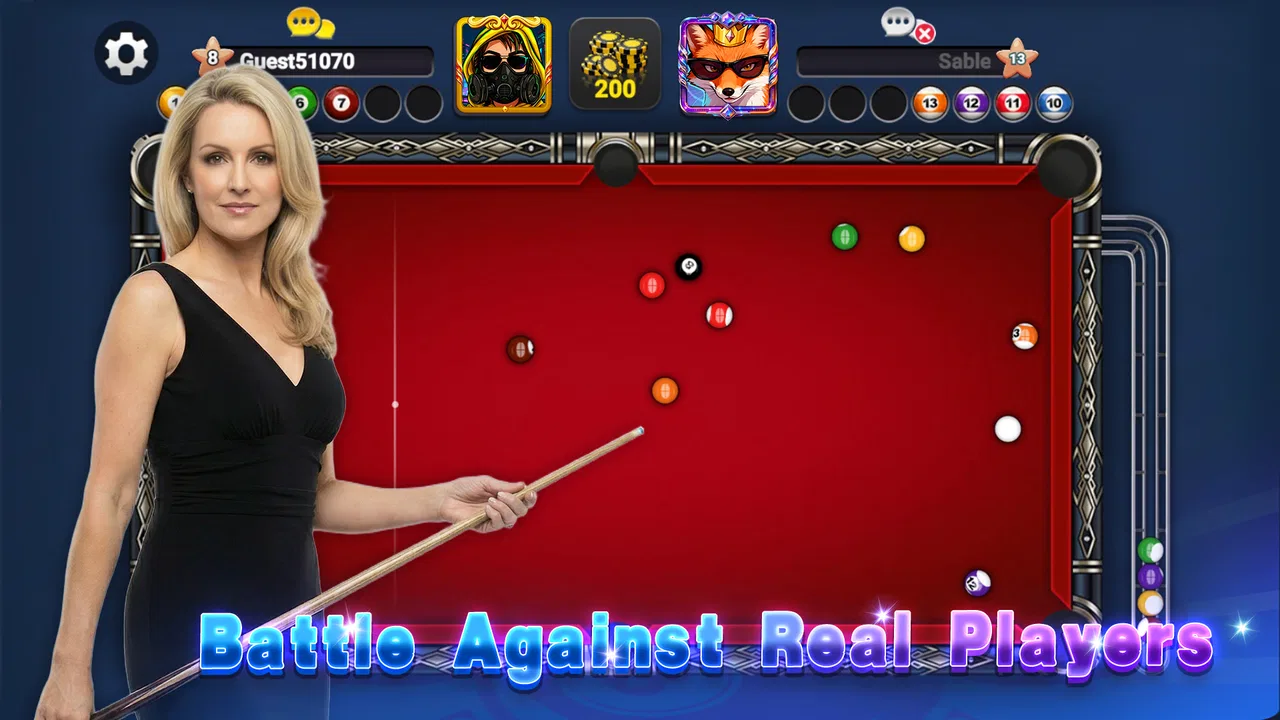
What I like most is the narrow focus. Billiards does not need a complicated control scheme to be engaging. The challenge comes from choosing the right ball, judging the angle, controlling force, and thinking about the next position. On a touchscreen, that creates a useful balance: the actions are simple to understand, but a careless shot can still change the whole table.
That makes it a good fit for short breaks. I can imagine opening it while waiting for an appointment, playing a match during a commute when conditions are safe and stationary, or using it as a relaxed evening game that does not require a long story or a large mental commitment. The online structure also gives a match a clear beginning and end, unlike an endless arcade mode that can be difficult to put down.
The trade-off is that this simplicity can expose repetition. If you want career management, several sports, elaborate character progression, or a deep offline campaign, this is not the right kind of sports game. Its identity is tied to eight-ball pool, so the enjoyment depends heavily on whether arranging shots and managing the table remains interesting to you.
Practical shot habits that make a difference
My first useful habit is to stop treating every shot as a chance to pocket a ball immediately. Before aiming, I look at where the cue ball is likely to finish. A difficult pot may be technically possible, but leaving the cue ball behind another group can make the next turn much worse. In a mobile match, choosing a safer position can be more valuable than attempting a spectacular shot.
A second habit is to use less power than instinct suggests. Strong shots feel attractive because they seem decisive, but they also make the cue ball harder to control. I prefer gentle or moderate force whenever the table allows it. This is especially helpful when I am trying to avoid handing an easy opening to the opponent after a miss.
I also recommend taking a moment to inspect the complete table before committing. The best target is not always the nearest one. Look for clusters, blocked pockets, and the ball that could become awkward later. Thinking one or two shots ahead turns the game from simple tapping into a small planning exercise, which is where much of its lasting appeal lies.
These habits are also a way to decide whether the game suits you. Someone who enjoys precision and gradual improvement will probably find more depth here than someone looking for constant action. The controls may be approachable, but the difference between a lucky pot and a controlled clearance comes from patience.
Online play and the everyday experience
The online focus gives each match a social and competitive edge. Even when the rules are familiar, playing against another person makes a missed safety shot feel more important than it would against a passive practice target. I enjoy that tension in small doses, particularly when both players have a chance to recover from an imperfect opening.
It also means the game is less suitable when you want a completely private, interruption-free activity. Online matches ask for attention at the right moment, and a poor connection or an unexpected interruption can spoil a session. I would not begin a match when I know I may need to close the game immediately. A short game is still a commitment once another player is involved.
For a realistic daily scenario, imagine having ten minutes before leaving home. I would open the game, play one match, and use the time to practice controlled power rather than chasing risky shots. If I won, I could stop while the session still felt satisfying; if I lost, I could identify whether the problem was poor positioning or over-aggressive aiming instead of immediately trying to recover the result. That approach keeps the game recreational rather than letting a quick break turn into an unplanned spending or replay cycle.
Where it compares well with other mobile pool choices
Compared with a purely offline billiards game, this title is more appealing if your main reason for playing is the uncertainty of an online opponent. An offline alternative can be better for practice, travel, or situations where you do not want a live match to depend on your availability. The choice is therefore less about which game is universally superior and more about whether you value connected competition over uninterrupted solo play.
Compared with a larger sports title, Billiards 8 Ball: Pool Games is easier to understand and quicker to enter. You do not need to learn several sports or manage a complicated roster. That focus is its strength for casual players, but it is also its limitation for anyone who expects a broad sports package.
It may also suit players who prefer deliberate skill over rapid reactions. A racing or action game can test timing at high speed, while pool gives me more room to study the situation before acting. On the other hand, players who need constant movement and immediate feedback may find a table-based match too quiet, especially after the first few sessions.
Readability, navigation, and the first match
For a new player, the practical test is whether the table and shot controls make sense quickly enough to let you focus on decisions. Eight-ball’s familiar objective helps: even without mastering advanced tactics, I can understand what a turn is asking me to do. That lowers the learning burden compared with sports games that begin with teams, menus, and several rule sets.
I would still take the first match slowly rather than assume that a familiar game is automatically easy on a touchscreen. Before committing to a shot, check the aiming direction and force you are setting, then watch where the cue ball ends up. That small pause helps separate a poor strategic choice from a shot that simply had more power than intended. If the visual presentation feels crowded or difficult to follow on your device, a larger-screen option may be more comfortable than trying to compensate by rushing.
Motor and sensory comfort at the table
Pool is less dependent on rapid repeated input than many action games, which can make its pace more comfortable for players who prefer deliberate gestures. Still, aiming and adjusting power call for controlled touchscreen movement. I would not assume that this suits every hand, grip, or level of precision. If small movements are tiring or inconsistent for you, try a few free matches before deciding whether the controls feel manageable.
The game’s quieter, turn-based rhythm may also be a welcome alternative to games filled with constant motion. But that does not make it universally comfortable: following a crowded table and judging angles still requires visual attention. If you play in a bright place, on a small display, or while distracted, pause between turns and inspect the whole table rather than relying on a quick glance. This is a game where a moment of care can matter more than speed.
Choosing the right place and time to play
The short-match format works best when you can give an opponent your attention from the opening shot to the finish. A waiting room or a quiet break can be a sensible setting; a busy walk, a stop-start task, or a commute where you need to stay alert is not. I would save an online match for a moment when I can sit still and finish it, rather than treating it like a game that can always be abandoned without consequence.
That distinction helps answer a common practical question: is it suitable for a quick session? Yes, if “quick” means a limited, focused break and you can remain available until the match ends. If you need something that can be paused at any instant, a solo puzzle or offline practice game is the safer choice. The value of online play comes with a small responsibility to the person on the other side of the table.
What the rating and age label mean for a new player
The Everyone content rating makes the game approachable for a broad audience. I would still explain the online nature and optional purchases to younger players before handing over a device, not because the age label makes the game unsuitable, but because connected competition and spending choices deserve sensible supervision.
The 4.8 average is encouraging, and the game has around forty written reviews. I see that as a useful sign that players are responding positively, but not as a guarantee that the controls, match pace, or purchase approach will fit every device and preference. Ratings are most helpful when combined with a personal trial, and the free entry makes that trial straightforward.
Who should spend time with it
I think this game is a strong match for someone who already enjoys eight-ball rules and wants a compact online version on Android. It is also suitable for a beginner who wants to learn through repeated matches rather than read a long tutorial first. The basic idea is familiar, and improvement comes naturally from noticing why a shot failed.
It can be especially useful for players who like low-pressure competition. You can focus on cue-ball control, defensive positioning, and consistency without needing the reflexes demanded by many other sports games. A patient player may get more from it than a player who simply tries to hit every ball as hard as possible.
I would skip it if your priority is a substantial offline experience, a wide selection of sports, or a game with a clearly defined long-term adventure. I would also skip it if online matches are inconvenient for your routine or if optional purchases make free-to-play games uncomfortable. In those cases, a paid offline pool game may offer a better fit if its upfront cost and features match your expectations.
My decision on value
My recommendation is to try Billiards 8 Ball: Pool Games for free, with a spending boundary decided before you start. The free access is enough to test the central experience, and the game’s focused design makes it easy to understand within a short session. For me, its best qualities are the simple entry point, the thought required behind each shot, and the added tension of online play.
The limitations are just as clear. This is not a full sports collection, and its appeal can narrow if repeated eight-ball matches do not hold your attention. Online play may not suit every schedule, while the optional purchase range means paid extras should be judged carefully rather than assumed to be necessary.
After trying it, I would keep it installed if I wanted quick competitive pool matches and enjoyed improving through better positioning. I would remove it if I mainly wanted offline practice or more variety. The sensible buy-or-skip verdict is simple: play for free first, pay only when a specific purchase clearly improves the way you personally use the game. That makes the title a worthwhile recommendation for focused pool fans, but not a universal replacement for every billiards or sports game.
Mentha X Games has chosen a clear direction instead of trying to turn the table into an oversized sports package. For the right player, that clarity is valuable. I would recommend giving it a fair trial, learning to control the cue ball before chasing difficult pots, and treating every optional purchase as a choice rather than an obligation.
FAQs for Billiards Legend: Pocket Games
01What are the main features of Billiards 8 Ball: Pool Games?
Billiards 8 Ball: Pool Games offers a realistic pool-playing experience with stunning 3D graphics and intuitive controls. Players can enjoy various game modes, including single-player, online multiplayer, and tournaments. The app also features customizable cues and tables, allowing players to personalize their gaming experience while competing with others globally.
02Is Billiards 8 Ball: Pool Games free to play?
Yes, Billiards 8 Ball: Pool Games is free to download and play. However, it contains in-app purchases for items such as premium cues, extra coins, and other enhancements. These purchases can enhance the gameplay experience, but they are entirely optional and not necessary to enjoy the game fully.
03Does Billiards 8 Ball: Pool Games require an internet connection?
While Billiards 8 Ball: Pool Games offers offline single-player modes, an internet connection is required for online multiplayer and tournaments. Playing online allows users to compete against players worldwide, track their rankings, and participate in special events and challenges that require connectivity.
04How suitable is Billiards 8 Ball: Pool Games for beginners?
Billiards 8 Ball: Pool Games is designed to be accessible for players of all skill levels. Beginners can start with tutorial modes and practice sessions to learn the basics of pool. The game’s intuitive interface and helpful guides make it easy for newcomers to quickly grasp the rules and improve their skills over time.
05What devices support Billiards 8 Ball: Pool Games?
Billiards 8 Ball: Pool Games is available on both Android and iOS platforms. It supports a wide range of devices, but it's recommended to check the specific system requirements on the app store page to ensure compatibility with your device. Regular updates help maintain compatibility with newer device models.
Pros
- Realistic physics enhance gameplay.
- Variety of game modes available.
- User-friendly interface design.
- Customizable pool cues and tables.
- Smooth online multiplayer experience.
Cons
- Occasional in-app ads can be intrusive.
- Limited offline game features.
- Requires internet for full functionality.
- Some in-app purchases are pricey.
- Graphics can be demanding on older devices.

Billiards Legend: Pocket Games
Gallery